


Abstract
Employee satisfaction remains a central theme in management, with substantial evidence linking it to organizational performance. This study examines the nature and strength of that relationship and investigates whether its magnitude varies across different performance indicators. Using existing data from 23 organizations where organization culture was assessed through the Denison Organizational Culture Survey (DOCS) between 2015 and 2022, the study analyzes 1532 employee responses. Organizational performance was evaluated across five dimensions: growth, profitability, quality of products and services, employee satisfaction, customer satisfaction, and overall performance. Bivariate regression analyses reveal positive and statistically significant relationships between employee satisfaction and all other performance indicators. The strongest associations were observed for overall performance and customer satisfaction, while moderate relationships emerged for profitability, growth, and quality of products and services. Employee satisfaction accounted for approximately 36% of the variance in overall performance. The findings support the view that employee satisfaction functions both as a driver and as an outcome of organizational performance. They further indicate that the strength of this relationship is greater for human-centered outcomes than for financial indicators. Practically, the results underscore the importance of cultivating intrinsic motivation, trust, and employee participation to enhance both satisfaction and perceived performance. Future research should investigate the causal direction between employee satisfaction and customer satisfaction and explore how organizational culture moderates this relationship across different sectors.
1. Introduction
This paper examines the relationship between employee satisfaction and organizational performance. Employee satisfaction has long been a core concern in human resource management and is influenced by a variety of intrinsic and extrinsic factors. Extrinsic factors relate to the work environment, compensation, and interpersonal relationships, while intrinsic factors involve employees’ internal experiences of their work—such as autonomy, meaning, challenge, and opportunities for professional development (Armstrong & Taylor, 2023).
Scholars continue to debate whether employee satisfaction directly affects performance or whether the relationship operates indirectly, for instance, through service orientation or engagement (Lytle & Timmerman, 2006; Susskind et al., 2018). Furthermore, performance has been differently defined. On one hand performance has been defined as human-centered indicators (e.g., customer satisfaction) and on the other hand as financial outcomes (e.g., profitability and growth) (Phan et al., 2021). Although job satisfaction has more often been related to human-centered outcomes (Panda et al., 2024), it has also been found related to financial outcomes and often indirectly (Kessler et al., 2020; Mittal et al., 2023). Evidence suggests that employee satisfaction can both enhance performance and arise from it, forming a reinforcing cycle that benefits employees and organizations alike (Cho & Choi, 2021; Saari & Judge, 2004).
Despite extensive research, questions remain regarding the relative strength of employee satisfaction across different dimensions and attributes of performance, particularly between human-centered indicators and financial outcomes. To address these questions, this study explores two research objectives:
- To what extent does employee satisfaction explain the variability of aggregated organizational performance outcomes?
- To what extent does the strength of this relationship differ across specific organizational performance indicators?
The study employs existing data from 23 organizations that used the Denison Organizational Culture Survey (DOCS) to assess workplace culture between 2015 and 2022. For the present analysis, a subset of items focusing on employee satisfaction and organizational performance was used. The DOCS framework is particularly suitable for this investigation because it explicitly links behavioral dimensions of organizational culture with measurable performance outcomes (Denison, 2000; Denison et al., 1995; Denison & Mishra, 1995; Denison & Spreitzer, 1991).
Participants were asked to assess their employee satisfaction and to compare various performance indicators of their organization with that of others in the same or similar industry. Performance indicators evaluated were sales growth, profitability, quality of products and services, customer satisfaction, and overall performance. This data provides a unique opportunity to examine how perceived job satisfaction corresponds with perceived organizational success, collectively and individually.
This study contributes to literature in several ways. First, it integrates the employee satisfaction–performance relationship within the context of organizational culture, an area often treated separately in previous research. Second, it differentiates between human-centered and financial performance indicators, thereby extending understanding of where the relationship is most pronounced. Finally, by drawing on a diverse dataset of organizations across sectors, it offers evidence that enhances the external validity of prior findings based on single-industry samples.
The paper is structured as follows. Section 2 reviews the theoretical foundations of job satisfaction and its connection to organizational performance. Section 3 describes the research design, data collection procedures, and analytical methods. Section 4 presents empirical results, followed by Section 5, which discusses the findings in relation to prior research, outlines managerial implications, and identifies directions for future study.
2. Theoretical Framework
This section reviews key theoretical and empirical work on job satisfaction and its relationship with organizational performance. It begins by defining the concept of job satisfaction and outlining its principal determinants, before turning to research on how satisfaction relates to performance outcomes across organizational contexts.
2.1. Employee Satisfaction
Employee satisfaction and job satisfaction have been extensively researched, and although some scholars distinguish between the two, we treat them as parallel concepts in this article. Because the measurement instrument used in our analyses employs the term employee satisfaction, we adopt this terminology throughout our figures and models, while conceptually treating it as equivalent to job satisfaction.
Job satisfaction has long been a central construct in human resource management and organizational psychology. It refers to the degree to which employees experience positive evaluations of their jobs and work environments (Spector, 1997). Organizations continually seek to foster conditions that enhance satisfaction, given their demonstrated links to motivation, commitment, and performance (Armstrong & Taylor, 2023; Das, 2024).
Multiple definitions of job satisfaction have been proposed (Brief & Weiss, 2002; Hoppock, 1935; Judge & Klinger, 2008; Locke, 1976; Spector, 1997, 2021; Weiss, 2002). Most view satisfaction as a pleasurable emotional state resulting from an employee’s appraisal of their job or job experiences (Locke, 1976; Das, 2024; Hasan et al., 2024). It thus reflects the interplay between psychological dispositions and environmental factors. In practical terms, satisfaction encompasses employees’ effective and cognitive evaluations of work attributes such as relationships with colleagues, compensation, supervision, and working conditions.
Job satisfaction is multifaceted and dynamic: It varies across individuals and situations and can change over time as expectations shift (Wilson et al., 2021). It also has both individual and organizational implications. On the individual level, satisfaction influences well-being and work attitudes; at the organizational level, it affects productivity, retention, and overall performance (Spector, 2021).
The origins of the modern satisfaction–performance debate can be traced to the Human Relations Movement and the Hawthorne studies, which suggested that improved social conditions and morale increase productivity (Mayo, 2003). Since then, numerous frameworks have sought to explain how specific job features drive satisfaction and performance (Hasan et al., 2024).
One of the most influential models is the Job Characteristics Model (Hackman & Oldham, 1980), which posits that intrinsic aspects of work—skill variety, task identity, task significance, autonomy, and feedback—trigger three critical psychological states: (1) experienced meaningfulness, (2) responsibility for outcomes, and (3) knowledge of results. These, in turn, enhance intrinsic motivation, satisfaction, and performance. The model predicts that employees who perceive their work as meaningful and have autonomy and feedback are more motivated and productive, with lower absenteeism and turnover.
Later research extended this framework to incorporate social and contextual influences. Morgeson and Humphrey (2006) demonstrated that coworker support, supervisory quality, and social interaction significantly influence satisfaction and performance through psychological mechanisms such as engagement and perceived meaning. Similarly, Van Wingerden et al. (2017) confirmed that autonomy and meaningful work enhance satisfaction and performance partly by increasing work engagement. Collectively, these findings reaffirm the enduring relevance of intrinsic motivation in explaining job satisfaction.
2.2. Employree Satisfaction and Organizational Performance
A substantial body of evidence supports a positive relationship between job satisfaction and organizational performance (Altamimi, 2019; Harter et al., 2002; Huselid, 1995). Early meta-analyses (Brayfield & Crockett, 1955; Fournet et al., 1966) showed that satisfied employees tend to exert greater effort and display higher productivity. Subsequent research, while occasionally reporting modest correlations, consistently finds that satisfaction is more often a cause than a consequence of performance (Bakotić, 2016).
Still, the relationship is complex and can be influenced by contextual and psychological factors. Vroom’s (1964) Expectancy Theory explains that performance depends on the alignment of effort, rewards, and individual expectations. Recent studies (Shdaifat et al., 2023) highlight that transparent reward systems and trust in management strengthen this link by motivating employees to invest greater effort.
Meta-analytic reviews further illuminate the dynamic nature of the relationship. Judge et al. (2001) reported an average correlation of r = 0.20 between job satisfaction and performance across 312 studies, while Spector (2021) suggested that satisfaction can act as both an antecedent and a consequence of performance through mechanisms such as recognition and rewards. This dual perspective reflects a self-reinforcing process in which satisfaction promotes performance, which then enhances satisfaction.
At the organizational level, satisfaction has been linked to lower absenteeism, higher commitment, and reduced turnover (Spector, 2021). Empirical studies across industries confirm that satisfied employees contribute to superior performance indicators, including profitability, efficiency, and customer satisfaction (Cemil, 2018; Ismail et al., 2021; Pang & Lu, 2018). For example, Chi and Gursoy (2009) found that job satisfaction indirectly influences financial performance via customer satisfaction, while Noercahyo et al. (2021) showed that engagement and learning mediate similar effects in the pharmaceutical sector.
Despite strong evidence for a positive relationship, researchers note that the magnitude of the effect varies with the performance dimension measured. Financial indicators such as growth or profitability often show weaker associations than human-centered outcomes like service quality or customer satisfaction (Dhiman & Arora, 2022; Miah, 2018). This distinction underscores the value of adopting a holistic perspective on organizational performance, encompassing both quantitative financial measures and qualitative indicators of employee and customer experience.
Performance assessments that rely solely on financial metrics may therefore underestimate the real drivers of organizational success. Balanced approaches that integrate human and financial outcomes—linking satisfaction, engagement, and customer orientation—provide a more accurate view of sustainable performance (Pavlov & Bourne, 2011). When employees perceive fairness, trust, and influence over their work environment, their commitment and long-term performance are enhanced (Dhiman & Arora, 2022). In summary, the literature converges on several key insights: (1) job satisfaction and organizational performance are positively related, though the strength of this relationship depends on contextual factors; (2) intrinsic motivation and meaningful work play pivotal roles in sustaining satisfaction and performance; and (3) a balanced, multi-dimensional view of performance—integrating financial and human outcomes—best captures the interplay between employee attitudes and organizational success.
3. Materials and Methods
This section outlines the study’s design, data collection procedures, and analytical approach used to examine the relationship between job satisfaction and organizational performance.
3.1. Research Design and Data Collection
The study assumes that variations in organizational performance, collectively and individually, can be partially explained by job satisfaction. It draws on existing data collected through the Denison Organizational Culture Survey (DOCS), which measures organizational culture and its connection to performance outcomes (Denison & Mishra, 1995). In each participating organization, respondents were asked to evaluate how well their organization performed relative to comparable organizations within the same industry. For this research only six questions from the instrument were used. One that assessed job satisfaction, and five that each represented a performance indicator. In all instances, a five-point interval scale was used.
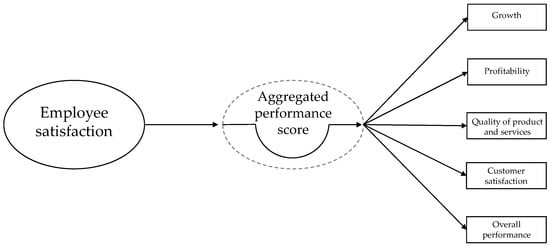
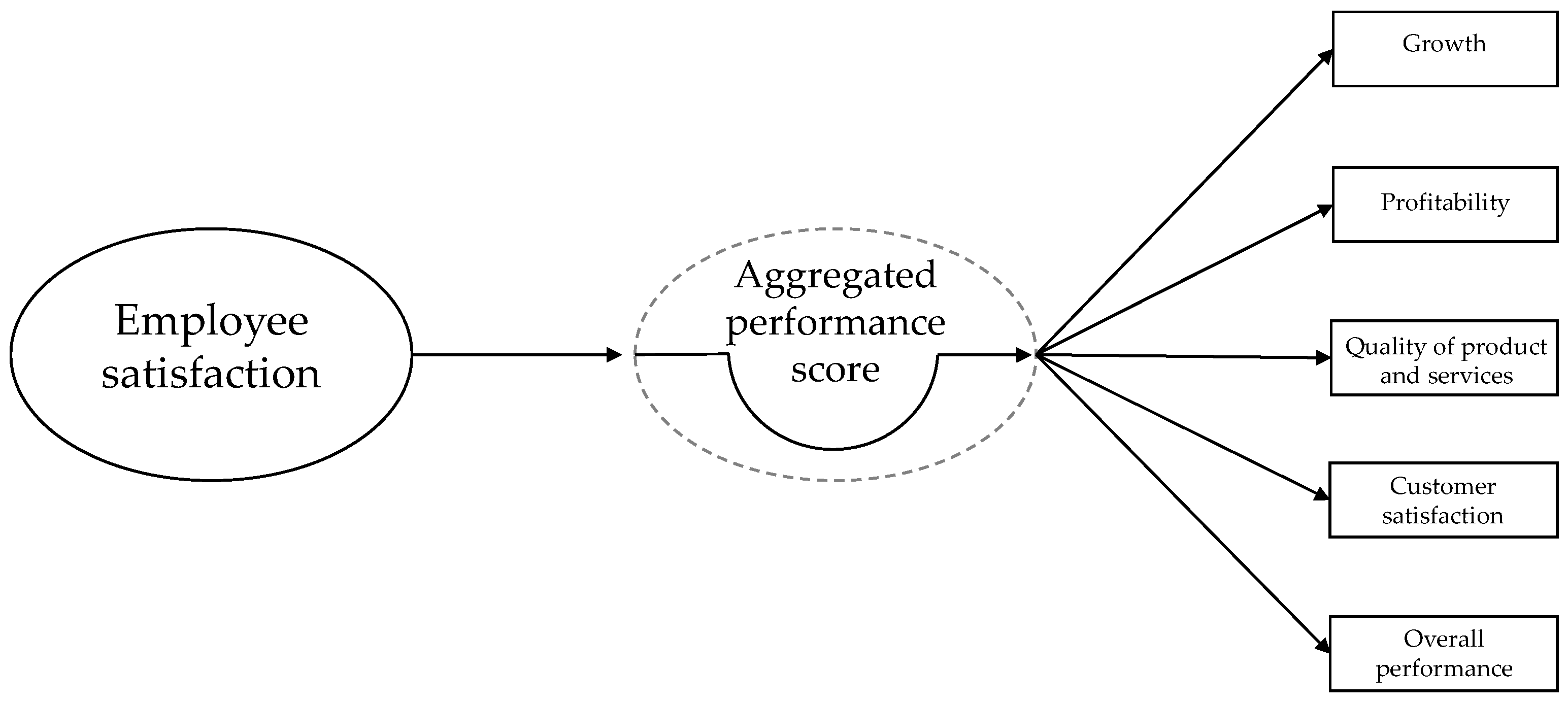
The hypothesized model, illustrating the expected positive relationship between job satisfaction and organizational performance, is presented in Figure 1. To investigate whether it would be appropriate to combine the performance variables into a single factor (aggregated performance score), principal component analysis (PCA) was used.
Figure 1.
A hypothesized model of the relationship between employee satisfaction and performance.
As shown in the figure, the hypothetical model comprises two models, each aligned with one research question. The former addresses the first questions that investigates the connection between job satisfaction and aggregated performance score. The latter goes beyond the aggregate score and determines the relationship strength towards each performance indicator.
Data collection was conducted either by the authors or by graduate students under their supervision as part of ongoing culture assessment and consultancy projects. The participants from each organization were individuals (employees and managers) who in their daily work influence, formulate, and/or implement strategy.
For the purposes of this study, data from 23 organizations were included, representing a range of industries and sectors. The inclusion criteria were recent data, organizations that have endured good market performance, even won awards, and diverse range of sectors. To ensure data quality surveys conducted between 2015 and 2022 were selected. Earlier data were excluded since the raw datasets were unavailable. More recent data was excluded since changes have been made to the DOCS instrument since then, that made comparability difficult (Nieminen et al., 2022).
After cleaning the data, removing incomplete responses or cases with insufficient answers to key variables, 1532 valid responses remained for analysis. The number of responses per organization varied considerably, from 12 to 302. To avoid bias due to unequal sample sizes, analyses were conducted using the organizational mean scores for each variable, thereby ensuring that each organization contributed equally to the overall model. To ensure anonymity of participants and organizations, data is only reported on aggregate per organization and organizations given numbered identities.
Descriptive statistics for all performance indicators are summarized in Table 1. The variation in means across organizations likely reflects differences in sectoral context, size, and organizational maturity, factors that lie beyond the scope of the current analysis.
Table 1.
Number of responses by organization and descriptive statistics for performance factors.
As can be seen in Table 1, the number of responses varies considerably across organizations, and so do respondents’ assessments of organizational performance. These differences may be attributable to a range of factors, such as organizational size, whether the organization operates on a for-profit or non-profit basis, and the age of the data. Since these factors lie beyond the scope of the present study, they are not discussed further here.
3.2. Measures
The DOCS instrument includes a set of items evaluating perceived organizational performance, covering the following dimensions: (1) sales growth, (2) profitability, (3) quality of product and services, (4) employee satisfaction, (5) customer satisfaction, and (6) overall performance score. In this study, as can be seen in Figure 1, employee satisfaction is the independent variable while other performance variables are defined as dependent variables.
3.3. Analytical Procedures
To assess the relationship between employee satisfaction and organizational performance, bivariate linear regression analyses were conducted. employee satisfaction served as the independent variable, while each of the five performance indicators—as well as their aggregate mean—served as dependent variables. Two metrics were used to interpret the results:
- Coefficient of determination (R2): indicating the proportion of variance in performance explained by employee satisfaction.
- Standardized beta coefficient (β): representing the strength and direction of the association.
Following Cohen’s (1988) guidelines, correlations were categorized as small (r ≈ 0.10), moderate (r ≈ 0.30), or strong (r ≥ 0.50).
4. Results
The first research question asked whether a relationship exists between employee satisfaction and organizational performance. The second examined whether the strength of this relationship differs across specific performance dimensions.
Table 2 presents descriptive statistics for employee satisfaction, the average performance score, and each performance indicator. On average, respondents rated their organizations’ performance above the midpoint of the scale, with particularly high evaluations for the quality of products and services. Employee satisfaction (M = 3.82, SD = 1.03) was slightly lower than the overall performance mean (M = 4.11, SD = 0.70).
Table 2.
Descriptive statistics for independent and dependent variables.
As shown, employee satisfaction received a lower mean score than aggregate performance score, while respondents rated quality of products and services the highest, followed by overall performance dimension. Organizational performance seems to be positively valued by respondents.
4.1. Correlations Among Performance Variables
As shown in Table 3, all performance indicators are significantly correlated, with coefficients ranging between 0.30 and 0.70.
Table 3.
Correlation between performance factors.
The results show that all correlations are statistically significant and exceed 0.3, which is desirable, while none are higher than 0.7, which is also preferable (Pallant, 2020).
To examine the relationship between job satisfaction and organizational performance, a linear regression analysis was conducted in which job satisfaction served as the independent variable, for the dependent variables on one hand the aggregate performance score and individual performance attributes on the other (see Figure 1, the hypothesized model).
To assess the strength of these relationships, two measures were used: the coefficient of determination (R2), indicating the proportion of variance explained, and the standardized beta coefficient (β), which also reflects the relative importance of individual predictors.
4.2. Regression Analyses
A series of simple linear regression models were estimated to determine the extent to which job satisfaction predicts organizational performance. Principle component analysis (PCA) yielded a single-factor solution for the five performance indicators explaining 58% of the variance in the data. The KMO value (0.792) and Bartlett’s test (p < 0.001 confirmed the adequacy of the data for factor analysis (Kaiser, 1974; Bartlett, 1954). Overall performance indicators loaded strongly on the factor (>0.70), supporting a unidimensional organizational performance construct (Pallant, 2020). Visual inspection of the scatterplot and residuals indicated an approximately liner relationship between ZRESID (Y) and ZPRED (X) supporting the assumption of linearity. Examination of outliers also showed that in all cases the standardized residual was within the reference range (−3.3 to 3.3) which also supports the assumption of linearity (Tabachnick et al., 2019). Results for aggregated performance scores and the five individual performance scores are summarized in Table 4.
Table 4.
Key values from the regression analysis.
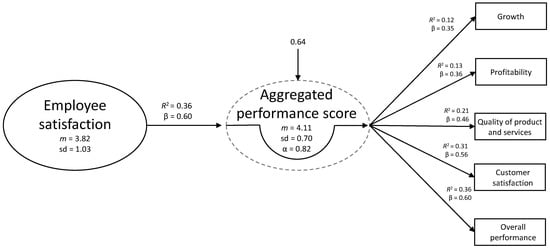
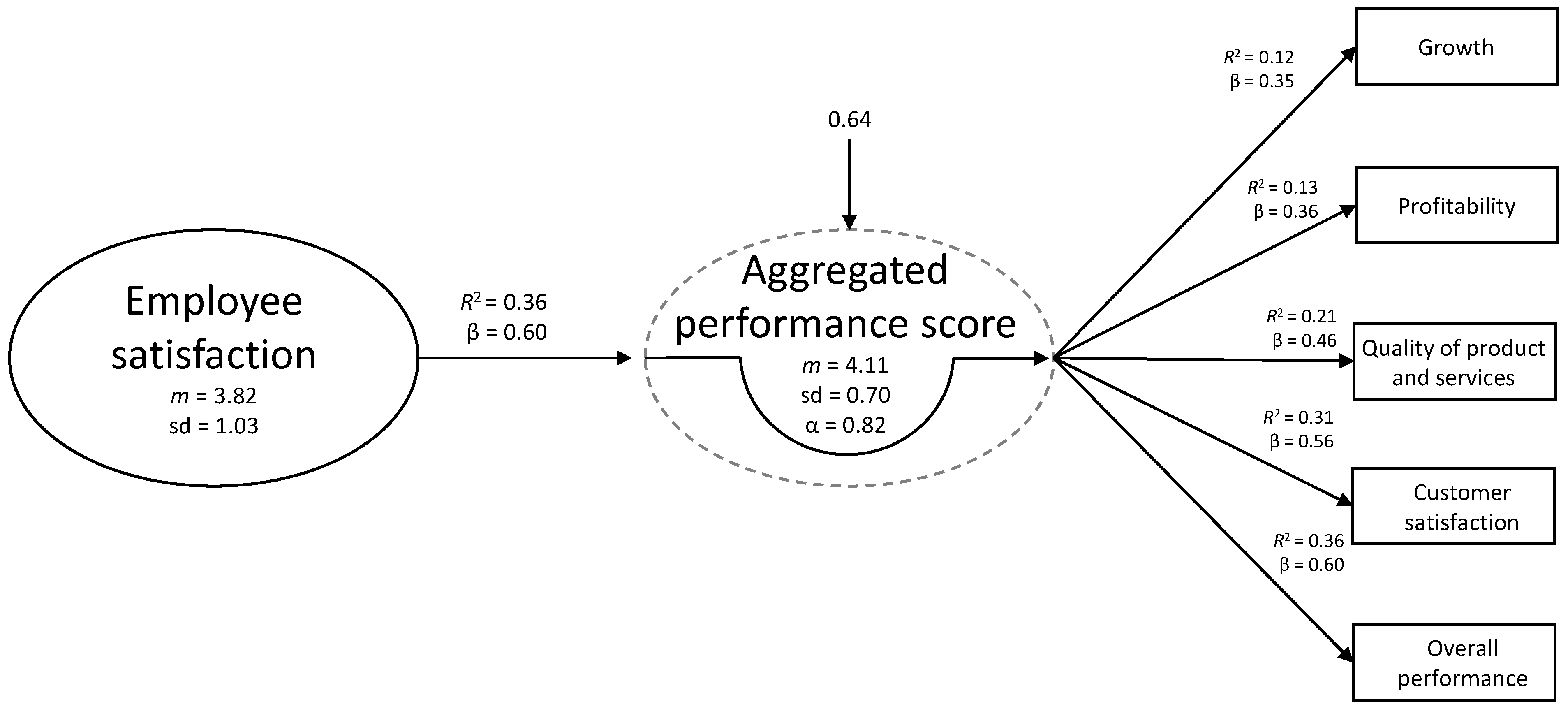
As shown in Table 4, all relationships are statistically significant (p < 0.001), although the coefficient of determination (R2) varies across the models. The explanatory power is notably highest for customer satisfaction and overall performance, and lowest for growth and profitability. These results are illustrated in greater detail in Figure 2.
Figure 2.
The relationship between employee satisfaction and performance.
As illustrated in Figure 2, employee satisfaction (M = 3.82, SD = 1.03) explains 36% of the variance in aggregated performance (M = 4.11, SD = 0.70), calculated as the mean of the five performance dimensions. It should be noted that the mean is based on those performance variables for which respondents provided ratings, and as shown in Table 2, the number of responses varies somewhat across dimensions.
When examining the individual performance indicators, employee satisfaction accounts for different proportions of the variance—ranging from 12% for growth, where the explanatory power is lowest, to 36% for overall performance, where it is highest. Similarly, the strength of the relationships, measured by the standardized beta coefficient (β), also varies by performance dimension: β = 0.35 for growth (lowest), β = 0.56 for customer satisfaction, and β = 0.60 for overall performance (highest).
Given that β effectively represents the correlation between the independent and dependent variables, the results can be interpreted using Cohen’s (1988) guidelines. Accordingly, the correlations are moderate (r = 0.30–0.49) or strong (r = 0.50–1.0) in all cases. The model illustrates the strongest relationship between employee satisfaction and overall performance, as presented in Figure 3.
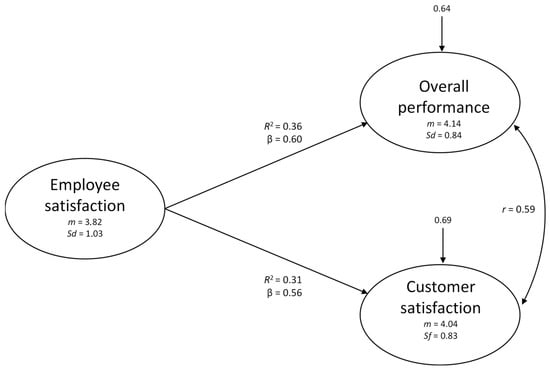
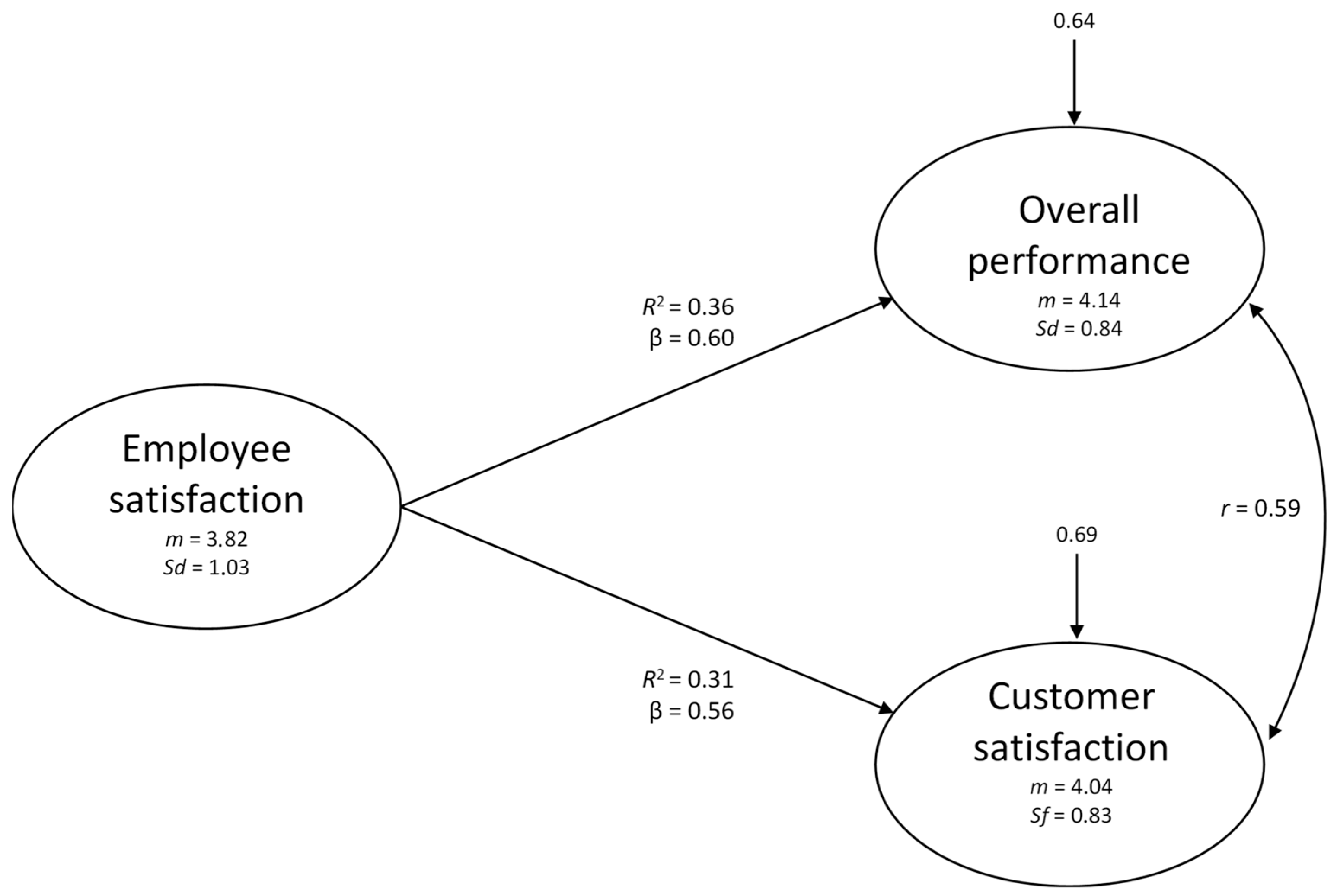
Figure 3.
The relationship of employee satisfaction with overall performance and customer satisfaction.
As illustrated on the figure, employee satisfaction explains 36% (R2 = 0.36) of the variance in overall performance and 31% (R2 = 0.31) of the variance in customer satisfaction. This indicates that a substantial proportion of the variability in these two dimensions is explained by factors other than employee satisfaction, that is outside of the scope of this research. The results collectively support the proposition that employee satisfaction exerts a broad and positive influence on perceived organizational performance, though the magnitude of this effect depends on the nature of the performance measure. The relationship is strongest for subjective, human-centered outcomes—such as customer satisfaction and perceived overall effectiveness—and comparatively weaker for objective financial indicators like profitability and growth.
5. Discussion
This section situates the study’s findings within the theoretical framework concerning the relationship between job satisfaction and organizational performance. The aim is to elucidate how the results support or diverge from previous research and to consider the theoretical and practical implications that may be drawn from them. The article addresses two research questions. The first concerns the strength of the relationship between employee satisfaction and aggregate organizational performance, measured as the average of five performance dimensions. The second question explores the strength of the relationship between employee satisfaction and each of the individual performance indicators. The hypothesized model underlying the study is presented in Figure 1.
The results indicate that employee satisfaction explains 36% (R2 = 0.36) of the variance in the average score across the five performance dimensions: growth, profitability, quality of products and services, customer satisfaction, and overall performance. According to Cohen’s (1988) criteria (r > 0.49), this represents a strong relationship (R2 = 0.36; β = 0.60). This provides compelling evidence that employee satisfaction can have a substantial and positive effect on organizational performance.
The findings align with prior research emphasizing that satisfied employees tend to display higher engagement, better service orientation, and stronger alignment with organizational goals (Chi & Gursoy, 2009; Hackman & Oldham, 1980; Pang & Lu, 2018). They also reinforce the theoretical proposition that employee satisfaction operates both as a cause and an outcome of performance (Bakotić, 2016, Spector, 2021). However, this would need to be investigated further in the future.
Addressing the second question, that examines the relationship between employee satisfaction and the individual performance dimensions, the strength of the associations varies. Although in all cases they exceed the threshold for what Cohen (1988) defines as a moderate correlation (r > 0.30). The relationships are strong for overall performance (R2 = 0.36; β = 0.60) and customer satisfaction (R2 = 0.31; β = 0.56). The association with quality of products and services is close to strong (R2 = 0.21; β = 0.46), while the relationships with profitability (R2 = 0.13; β = 0.36) and growth (R2 = 0.12; β = 0.35) are moderate.
These findings are in line with Dhiman and Arora (2022), claiming that employee satisfaction is stronger associated with human centered performance indicators, than financial ones. The results of the present study show a strong positive relationship between employee satisfaction and customer satisfaction (r = 0.56), which is consistent with the conclusions of Chi and Gursoy (2009). Furthermore, their study revealed that employee satisfaction has an indirect effect on financial outcomes through customer satisfaction. The interaction between employee and customer satisfaction therefore plays a critical role and warrants managerial attention. The findings also align with those of Bakotić (2016), who reported that the relationship between employee satisfaction and performance was considerably stronger than the reverse relationship, leading to the conclusion that job satisfaction is more likely to influence performance than vice versa.
Although employee satisfaction varies in its strength of association with different performance indicators, this distinction highlights the importance of adopting a holistic perspective on organizational performance—one that integrates both quantitative financial measures and qualitative indicators of employee and customer experience.
5.1. Theoretical Implications
This study advances literature in several important ways. First, it situates the employee satisfaction–performance relationship within the broader context of organizational culture, a connection that prior research has typically examined in isolation. Second, it distinguishes between human-centered and financial performance indicators, thereby offering clearer insight into the domains where the relationship is most pronounced. Finally, by drawing on a diverse sample of organizations from multiple sectors, the study provides evidence that strengthens the external validity of earlier findings that relied on single-industry data.
From a theoretical standpoint, this study extends existing models of the satisfaction–performance relationship by demonstrating that its strength is contingent on the nature of the performance indicator. Consistent with Herzberg’s (1966) two-factor theory and Hackman and Oldham’s (1980) Job Characteristics Model, the results underscore the role of intrinsic motivations such as meaningful work, autonomy, and recognition—in promoting both individual satisfaction and collective performance.
The findings also support the reciprocal model proposed by Saari and Judge (2004), in which employee satisfaction both influences and is influenced by performance. The stronger correlations observed regarding customer satisfaction and overall performance may reflect this bidirectional dynamic, suggesting that employees’ affective experiences at work translate into better customer interactions, which in turn reinforce satisfaction and commitment.
Furthermore, the results align with contemporary perspectives in sustainable human resource management, which posit that trust, empowerment, and participatory decision-making form the foundation of high-performing and psychologically healthy workplaces (Cho & Choi, 2021). By situating job satisfaction within a culture–performance framework, this study also bridges two streams of research—organizational culture and employee attitudes—that have often evolved separately.
5.2. Practical Implications
For practitioners, the findings highlight several actionable insights. First, enhancing intrinsic motivators—including meaningful work, autonomy, and opportunities for development—appears central to improving not only employee satisfaction but also perceived organizational performance. Second, trust-based leadership and employee involvement in decision-making processes can amplify satisfaction and strengthen organizational identification, thereby improving outcomes across both human and financial domains.
Managers should also note the particularly strong association between employee satisfaction and customer satisfaction. This link underscores the importance of internal service quality: satisfied employees are more likely to engage positively with customers, fostering loyalty and better organizational reputation. Investing in supportive work climates, recognition systems, and fair performance evaluations can thus yield both psychological and economic returns.
5.3. Limitations
While the study makes important contributions, several limitations should be acknowledged. First, it relies on single item measure, cross-sectional, self-reported data, which limits causal inference. While the observed relationships are strong, they cannot establish directionality between job satisfaction and performance. Second, the dataset draws on pre-existing surveys conducted for organizational culture assessments, which may not capture all facets of job satisfaction or contextual variables such as leadership style or psychological safety.
Third, the sample includes a larger proportion of private-sector organizations, and only a few large public-sector institutions. This imbalance could influence the generalizability of the results, as satisfaction–performance dynamics may differ across sectors with varying motivational structures and accountability systems. Finally, the reliance on perceived rather than objective performance indicators may introduce response bias, although perceptions themselves are often strong predictors of actual outcomes.
5.4. Future Research Directions
Future research should explore the causal directionality between employee satisfaction and customer satisfaction, whether employee satisfaction drives customer outcomes, or whether satisfied customers enhance employees’ sense of meaning and pride. Experimental or longitudinal designs could help clarify this dynamic.
Moreover, researchers should examine the moderating role of organizational culture, as the strength of the satisfaction–performance relationship may vary depending on whether the culture emphasizes innovation, stability, or participation. Including objective performance data, such as profitability or turnover rates, alongside perceptual measures could also enhance the robustness of future analyses. Finally, comparative studies across public and private sectors, across national contexts, or specific sector in comparison, could yield deeper insights into how institutional and cultural environments shape these relationships.
5.5. Conclusions
Overall, the findings demonstrate that job satisfaction is a central antecedent of perceived organizational performance, exerting particularly pronounced effects on customer satisfaction and overall outcomes. By situating the satisfaction–performance relationship within the broader domain of organizational culture and distinguishing between human-centered and financial performance metrics, the study clarifies the specific conditions under which this relationship is most salient. Moreover, the incorporation of a multi-sector dataset enhances the external validity of earlier single industry evidence, indicating that organizations with satisfied employees consistently achieve superior performance through strengthened service quality, improved customer experiences, and greater productivity. Practically, the findings suggest that cultivating an organizational culture that fosters intrinsic motivation, mutual trust, and meaningful employee involvement can generate substantive improvements in both job satisfaction and organizational performance. Theoretically, the results reaffirm that employee satisfaction functions simultaneously as a driver and an indicator of organizational effectiveness, an essential component of sustainable performance in contemporary and increasingly dynamic work environments.
Author Contributions
Conceptualization, M.H.A., T.G. and G.D.A.; Methodology, M.H.A. and T.G.; Validation, T.G.; Formal analysis, T.G.; Investigation, M.H.A., T.G. and G.D.A.; Resources, M.H.A., T.G. and G.D.A.; data curation, T.G.; Writing—original draft, M.H.A., T.G. and G.D.A.; Writing—review & editing, M.H.A. and T.G.; visualization, M.H.A., T.G.; Supervision, M.H.A.; Project administration, M.H.A. and T.G. All authors have read and agreed to the published version of the manuscript.
Funding
This research received no external funding.
Institutional Review Board Statement
Not applicable.
Informed Consent Statement
Not applicable.
Data Availability Statement
The data presented in this study are available on request from the corresponding author due to privacy of the partaking organizations.
Conflicts of Interest
The authors declare no conflicts of interest.
References
- Altamimi, A. N. A. (2019). Literature on the relationships between organizational performance and employee job satisfaction. Archives of Business Research, 7(4), 11–20. [Google Scholar]
- Armstrong, M., & Taylor, S. (2023). Armstrong’s handbook of human resource management practice. A guide to the theory and practice of people management (16th ed.). KoganPage. [Google Scholar]
- Bakotić, D. (2016). Relationship between job satisfaction and organisational performance. Economic Research-Economska Istrazivanja, 29(1), 118–130. [Google Scholar] [CrossRef] [Scilit]
- Bartlett, M. S. (1954). A note on the multiplying factors for various χ2 approximations. Journal of the Royal Statistical Society: Series B (Methodological), 16(2), 296–298. [Google Scholar] [CrossRef] [Scilit]
- Brayfield, A. H., & Crockett, W. H. (1955). Employee attitudes and employee performance. Psychological Bulletin, 52(5), 396–424. [Google Scholar] [CrossRef] [Scilit]
- Brief, A. P., & Weiss, H. M. (2002). Organizational behavior: Affect in the workplace. Annual Review of Psychology, 53(1), 279–307. [Google Scholar] [CrossRef] [Scilit]
- Cemil, K. (2018). Impact of health care employees’ job satisfaction on organizational performance support vector machine approach. Journal of Economics and Financial Analysis, 2(1), 45–68. [Google Scholar]
- Chi, C. G., & Gursoy, D. (2009). Employee satisfaction, customer satisfaction, and financial performance: An empirical examination. International Journal of Hospitality Management, 28(2), 245–253. [Google Scholar] [CrossRef] [Scilit]
- Cho, Y., & Choi, Y. (2021). When and how does sustainable HRM improve customer orientation of frontline employees? Satisfaction, empowerment, and communication. Sustainability, 13(7), 3693. [Google Scholar] [CrossRef] [Scilit]
- Cohen, J. W. (1988). Statistical power analysis for the behavioral sciences (2nd ed.). Lawrence Erlbaum Associates. [Google Scholar]
- Das, B. (2024). Job satisfaction and its importance: A review of literature. Quest Journals, Journals of Research in Business and Management, 12(3), 29–37. [Google Scholar]
- Denison, D. R. (2000). Organizational culture: Can it be a key lever for driving organizational change? In C. L. Cooper, S. Cartwright, & P. C. Earley (Eds.), The international handbook of organizational culture and climate. Wiley. [Google Scholar]
- Denison, D. R., Hooijberg, R., & Quinn, R. E. (1995). Paradox and performance: Toward a theory of behavioral complexity in managerial leadership. Organizational Science, 6(5), 524–540. [Google Scholar] [CrossRef] [Scilit]
- Denison, D. R., & Mishra, A. K. (1995). Toward the theory of organizational culture and effectiveness. Organizational Science, 6(2), 204–223. [Google Scholar] [CrossRef] [Scilit]
- Denison, D. R., & Spreitzer, G. (1991). Organizational culture and organizational development: A competing-value approach. In R. W. Woodman, & W. A. Passmore (Eds.), Research in organizational change and development (pp. 1–21). JAI Press. [Google Scholar]
- Dhiman, P., & Arora, S. (2022). Identifying service performance gap: A hospitality management perspective. International Journal of Productivity and Quality Management, 37(3), 305–322. [Google Scholar] [CrossRef] [Scilit]
- Fournet, G. P., Distefano, M. K., Jr., & Pryer, M. W. (1966). Job satisfaction: Issues and problems. Personnel Psychology, 19(2), 165–183. [Google Scholar] [CrossRef] [Scilit]
- Hackman, J. R., & Oldham, G. R. (1980). Work redesign. Addison-Wesley. [Google Scholar]
- Harter, J. K., Schmidt, F. L., & Hayes, T. L. (2002). Business-unit level relationship between employee satisfaction, employee engagement, and business outcomes: A meta-analysis. Journal of Applied Psychology, 87(2), 268–279. [Google Scholar] [CrossRef] [Scilit]
- Hasan, J., Hasan, M., Rahman, A., & Hossain, M. (2024). Job satisfaction theories: A literature review. IST Journal on Business & Technology, 8(1), 97–108. [Google Scholar]
- Herzberg, F. (1966). Work and the nature of man. World Publishing Company. [Google Scholar]
- Hoppock, R. (1935). Job satisfaction. Harper & Brothers. [Google Scholar]
- Huselid, M. A. (1995). The impact of human resource management practices on turnover, productivity, and corporate financial performance. Academy of Management Journal, 38, 635–672. [Google Scholar] [CrossRef] [Scilit]
- Ismail, F., Imran, M., & Al Hosni, A. A. H. (2021). The influence of job satisfaction and organizational culture on organizational performance: Empirical evidence from Pakistan’s banking sector. Webology, 18(3), 1–16. [Google Scholar]
- Judge, T. A., & Klinger, R. (2008). Job satisfaction: Subjective well-being at work. In M. Eid, & R. J. Larsen (Eds.), The science of subjective well-being (pp. 393–413). Guilford Press. [Google Scholar]
- Judge, T. A., Thoresen, C. J., Bono, J. E., & Patton, G. K. (2001). The job satisfaction-job performance relationship: A qualitative and quantitative review. Psychological Bulletin, 127, 376–407. [Google Scholar] [CrossRef]
- Kaiser, H. F. (1974). An index of factorial simplicity. Psychometrika, 39(1), 31–36. [Google Scholar] [CrossRef] [Scilit]
- Kessler, S. R., Lucianetti, L., Pindek, S., Zhu, Z., & Spector, P. E. (2020). Job satisfaction and firm performance: Can employees’ job satisfaction change the trajectory of a firm’s performance? Journal of Applied Social Psychology, 50(10), 563–572. [Google Scholar] [CrossRef] [Scilit]
- Locke, E. A. (1976). The nature and causes of job satisfaction. In M. D. Dunnette (Ed.), Handbook of industrial and organizational psychology (Vol. 1, pp. 1297–1343). Rand McNally. [Google Scholar]
- Lytle, R. S., & Timmerman, J. E. (2006). Service orientation and performance: An organizational perspective. Journal of Services Marketing, 20(2), 136–147. [Google Scholar] [CrossRef] [Scilit]
- Mayo, E. (2003). The human problem of an industrial civilization. Routledge. [Google Scholar] [CrossRef] [Scilit]
- Miah, M. M. (2018). The impact of employee job satisfaction toward organizational performance: A study of private sector employees in Kuching, East Malaysia. International Journal of Scientific and Research Publications, 8(12), 270–278. [Google Scholar] [CrossRef] [Scilit]
- Mittal, V., Han, K., Frennea, C., Blut, M., Shaik, M., Bosukonda, N., & Sridhar, S. (2023). Customer satisfaction, loyalty behaviors, and firm financial performance: What 40 years of research tells us. Marketing Letters, 34(2), 171–187. [Google Scholar] [CrossRef] [Scilit]
- Morgeson, F. P., & Humphrey, S. E. (2006). The Work Design Questionnaire (WDQ): Developing and validating a comprehensive measure for assessing job design and the nature of work. Journal of Applied Psychology, 91(6), 1321–1339. [Google Scholar] [CrossRef] [Scilit]
- Nieminen, L. R., Denison, D. R., Biermeier-Hanson, B., & Heinz-Oehler, K. (2022). Organizational culture and coaching. In International handbook of evidence-based coaching: Theory, research and practice (pp. 691–701). Springer. [Google Scholar]
- Noercahyo, U. S., Maarif, M. S., & Sumertajaya, I. M. (2021). The role of employee engagement on job satisfaction and its effect on organizational performance. Jurnal Aplikasi Manajemen, 19(2), 296–309. [Google Scholar] [CrossRef] [Scilit]
- Pallant, J. (2020). SPSS survival manual. A step by step guide to data analysis using IBM SPSS (7th ed.). Open University Press. McGraw-Hill Education. [Google Scholar]
- Panda, M. R. K., Raghav, A. S., Rukadikar, C., Tathagat, T., Rukadikar, A. R., & Kalita, J. P. (2024). Exploring the relationship between job satisfaction and employee performance: A meta-analysis. Journal of Information Systems Engineering and Management, 10(3), 1439–1451. [Google Scholar] [CrossRef] [Scilit]
- Pang, K., & Lu, C.-S. (2018). Organizational motivation, employee job satisfaction and organizational performance: An empirical study of container shipping companies in Taiwan. Maritime Business Review, 3(1), 36–52. [Google Scholar] [CrossRef] [Scilit]
- Pavlov, A., & Bourne, M. (2011). Explaining the effects of performance measurement on performance: An organizational routines perspective. International Journal of Operations & Production Management, 31(1), 101–122. [Google Scholar] [CrossRef] [Scilit]
- Phan, T. K., Nguyen, T. H. T., Dang, T. H., Tran, V. T., & Le, K. N. (2021). Non-financial factors affecting the operational performance of hospitality companies: Evidence from Vietnam. Problems and Perspectives in Management, 19(4), 48–62. [Google Scholar] [CrossRef] [Scilit]
- Saari, L. M., & Judge, T. A. (2004). Employee attitudes and job satisfaction. Human Resource Management, 43(4), 395–407. [Google Scholar] [CrossRef] [Scilit]
- Shdaifat, E. A., Shudayfat, T., & Al-Shdayfat, N. (2023). Understanding the mediating effects of commitment and performance on the relationship between job satisfaction and engagement among nurses. The Open Nursing Journal, 17, 1–7. [Google Scholar] [CrossRef] [Scilit]
- Spector, P. E. (1997). Job satisfaction: Application, assessment, causes, and consequences. Sage Publications. [Google Scholar] [CrossRef] [Scilit]
- Spector, P. E. (2021). Industrial and organizational psychology: Research and practice (8th ed.). Wiley. [Google Scholar]
- Susskind, A. M., Kacmar, K. M., & Borchgrevink, C. P. (2018). Guest–server exchange model and performance: The connection between service climate and unit-level sales in multiunit restaurants. Journal of Hospitality & Tourism Research, 42(1), 122–141. [Google Scholar] [CrossRef] [Scilit]
- Tabachnick, B., Fidell, L., & Ullman, J. (2019). Using multivariate statistics (2nd ed., Vol. 5). Pearson. [Google Scholar]
- Van Wingerden, J., Derks, D., & Bakker, A. B. (2017). The impact of personal resources and job crafting interventions on work engagement and performance. Human Resource Management, 56(1), 51–67. [Google Scholar] [CrossRef] [Scilit]
- Vroom, V. (1964). Work and motivation. Wiley and Sons. [Google Scholar]
- Weiss, H. M. (2002). Deconstructing job satisfaction: Separating evaluations, beliefs and affective experiences. Human Resource Management Review, 12(2), 173–194. [Google Scholar] [CrossRef] [Scilit]
- Wilson, A., Zeithaml, V. A., Bitner, M. J., & Gremler, D. D. (2021). Service marketing: Integrating customer focus across the firm. McGraw Hill. [Google Scholar]

Disclaimer/Publisher’s Note: The statements, opinions and data contained in all publications are solely those of the individual author(s) and contributor(s) and not of MDPI and/or the editor(s). MDPI and/or the editor(s) disclaim responsibility for any injury to people or property resulting from any ideas, methods, instructions or products referred to in the content. |
© 2026 by the authors. Licensee MDPI, Basel, Switzerland. This article is an open access article distributed under the terms and conditions of the Creative Commons Attribution (CC BY) license.